
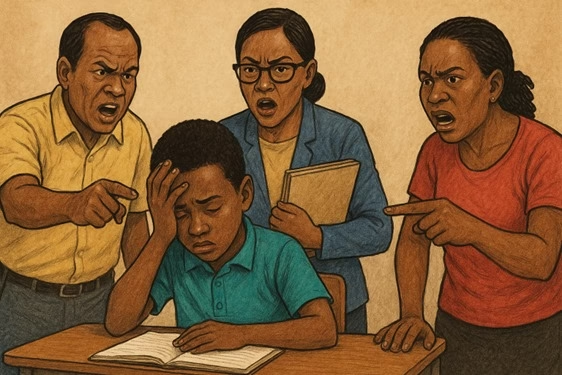
Courage Senator was constantly teased by his peers and punished by his teachers for his poor performance in school. Punishments included kneeling for long hours with his hands raised or caning on his buttocks and at age 11, he dropped out of school running errands for market women and helping transport drivers offload cargo in the Kaneshie Market.
In many African homes, the conversation around children’s academic performance often starts with an accusation and ends with frustration. A child comes home with his report card, dreading the reaction of his parents which may usually be a heart-piercing remark like, “Wo ti awu papa” meaning, “You are so dull!” or “After all the school fees we pay, is this the results you bring home?” This is usually followed by a slew of unprintable insults, rained on the child, which may create a dent in their confidence eventually, seeping into other areas of their lives. But is offense the best way to address this problem?
Is Your Child Really Lazy or Daft?
There’s a dangerous oversimplification at play when we always attribute poor academic performance to laziness or daftness. It’s easy, even convenient, to place all responsibility on the child. But what if the child has never been taught how to learn? What if they’re dealing with an undiagnosed learning disability or emotional trauma? What if the very structure designed to help them – school, home, or both – is failing them?
Why Punishment Fails
When we rely on punishment – be it caning, yelling, insulting or taking away privileges – we often tackle the symptoms, not the root. Fear-based methods may temporarily boost grades, but they create anxiety and diminish intrinsic motivation. They do not teach children how to improve; they only push them to avoid failure. And avoidance is not learning, it is a road to mediocrity.
So, what really causes a child to struggle academically? Let’s look at some deeply interconnected reasons:
- Learning Disabilities: In many African contexts, disabilities like dyslexia or Attention Deficit Hyperactive Disorder (ADHD) go undiagnosed due to lack of awareness, fear of stigma or lack of screening. A child with undiagnosed dyslexia, for example, may be scolded or beaten for inability to read properly when what they need is specialized support in the form of alternative learning methods and other solutions.
- No Study Structure: Children are rarely taught how to study. Why do schools provide timetables for learning and yet the child has none to guide their personal studies? They will naturally avoid tough subjects and topics, and rather focus their energies on areas they naturally enjoy or have no difficulty in.
- Permissive or Chaotic Home Environments: Some homes enable laziness and complacency in children. When a child displays these behaviors and goes uncorrected by a parent or guardian, when they have no boundaries or sense of what is necessary and what is frivolous at any point in time, they become unresponsive to correctional interventions when they mature. When they are often left to figure things out on their own, children develop inconsistent habits.
- Outdated Teaching Techniques: Many teachers still rely solely on traditional teaching methods and a one-size-fits-all approach to teaching. Each child has their unique learning strengths and weaknesses and using one teaching method to introduce a topic or concept to all the children is bound to be ineffective to some. Typically, lecture-based and test-focused instructional methods neglect different learning styles like visual, auditory, or kinesthetic.
- ADHD & Overstimulation: Excessive sugar intake, consumption of ultra-processed food, and constant exposure to short-form videos (on TikTok and YouTube Shorts) can overstimulate the brain, making focus difficult. Attention-Deficit Hyperactivity Disorder (ADHD) is also mostly undiagnosed in African communities. The wide ignorance of this disorder usually leads to the problem of considering fewer reasons for children’s poor academic performance.
- Other Overlooked Factors include lack of motivation, emotional trauma, poverty, and inadequate resources.
So, What’s the Alternative?
Note that the natural human reaction to harsh criticism includes withdrawal or rebellion. Let’s explore each stakeholder’s role:
1. Parents
Paying school fees is not the end of parental responsibility – it’s the beginning.
- You can use educational apps to support your child’s learning. Platforms like Duolingo (for languages), Khan Academy / Khan Academy Kids, or ScratchJr (for young coders) can turn screen time into productive learning time. Even a simple search for ‘study techniques for kids’ on Google or YouTube can expose you to modern strategies you might not be familiar with.
- Create Structured Routines and guided learning experiences for your child. Children learn from their experiences from a tender age. They have to be taught when to study, what to study and how to study. Apps like Smart Timetable and Kids Todo List can help you plan time for their homework, chores, play, rest and any other activity. Teach them to manage their focus and energy levels while studying by taking short breaks and avoiding distractions during studies. Help them plan their week, schedule which subjects to learn at which time and prioritize.
- Studies show children who do age-appropriate chores develop executive function skills – planning, focus, and memory. Including tasks such as cooking, cleaning, washing in addition to their academics teaches them to be responsible and positively affects their academics.
- Encourage and allow your children to engage in non-academic activities like sports, arts, coding, contesting and taking up leadership roles which foster creativity, confidence, and leadership skills.
- Consider seeking medical advice when you realize your child is having difficulties focusing, performing poorly in their academics, having difficulties reading or understanding certain concepts taught.
Avoid comparing your child to others. Instead, be a mirror and magnifying glass – reflecting their growth and helping them examine areas of improvement.
2. Students
Note that you are the one primarily responsible for how your life turns out. Your parents, teachers and other stakeholders can only do as much as their experience and strength will allow them. Note the following to ensure you take control of your academics:
- Share any academic difficulties you may have, share those challenges with a trusted person like a teacher who can help you overcome them. Experience and age have taught them more than you may know at your age, so don’t allow shame and fear to keep you mute. Remember, a problem shared is a problem halved!
- Be self-aware enough to know which learning method works best for you. Do videos help?. You can redirect time spent on social media to searching on YouTube for the topics you have difficulties in. You will find enough valuable explanations that will help you understand better. Do you understand better when a friend explains or in the morning when you still have much energy? Just experiment with different learning strategies until you find one that clicks. You are not dull, you are unique!.
- If it takes a while before concepts stick, or you need to revise more times before you understand, or you quickly forget new concepts, then you need to reduce time spent with friends in conversations that contribute no real value? Learn to manage your time properly and know that there is time for everything under the sun.
3. Teachers
- Use varied teaching methods to accommodate different learners. ICT has opened the door to differentiated instructions. With access to interactive platforms like Asanka, Khan Academy, or even YouTube Education channels, teachers can cater to visual, auditory, and kinesthetic learners in their classrooms. It also allows students to learn at their own pace – pausing, replaying, and practicing as needed.
- Be observers and advocates – recognizing when a student needs psychological or academic support.
- Encourage a growth mindset: Rephrase remarks directed at students from attacking their personality to encouraging them to change a habit or adopt one. For instance: “You haven’t mastered this topic yet,” rather than “You’re too dull.” You also develop one by accepting that you have more room for improvement.
4. Government and Educational Leaders
- Train teachers in inclusive education and learning difference identification. Support teachers to integrate digital tools like interactive whiteboards, learning management systems, and digital assessment tools for more effective teaching and learning.
- Provide counseling and therapy services in schools. This ensures students can have a safe space to seek psychological help that may be hampering their studies.
- Improve infrastructure and learning materials for all schools – not just urban ones. This will reduce the huge student numbers per class ensuring the teacher to student ratio doesn’t sabotage learning progress. Infrastructure includes classrooms, computers, internet connectivity, e-learning platform subscriptions, and more.
- Actively monitor the teaching delivery in schools to ensure teachers are practicing what they have been taught.
Courage was later discovered by an NGO, diagnosed with ADHD, received the necessary help and was re-enrolled in school. One can only imagine how a seemingly harmless approach by the teacher and fellow students could have permanently marred Courage’s future and those whose future depends on him.
To conclude, academic success isn’t just the child’s responsibility. It’s a collective mission – a village effort. Let us question the narrative and start redistributing responsibilities with wisdom, compassionately, and effectively.
Author: Deborah Ofori-Dartey | Digital Skills Training Supervisor at IIPGH | Member, IIPGH
For comments, contact deborah.dartey@iipgh.org or info@iipgh.org.
Sources:
The Truth about ADHD in African Communities | MEP Fit Person Channel | https://youtu.be/7BGLni12QGE?si=6RwiRCKVYfr0zAeH
Why African Parents NEED To Understand ADHD in 2025 | MEP Fit Person Channel | https://youtu.be/ihsv1lm-5eg?si=zsX6Lt17lTTchBi1
Some Ghanaian Children With Learning Disabilities Finally Get Effective Education | Global Press Journal | https://globalpressjournal.com/africa/ghana/long-beaten-for-inattention-some-ghanaian-children-with-learning-disabilities-finally-get-effective-education/


